Advertising in ChatGPT has been a topic of interest for many marketers and entrepreneurs since August 24, 2026. The main reason: ads are finally visible to ChatGPT users in the Netherlands and other European markets, but the way it works is different from what many people expect.
The core concept is simple. You can advertise within the conversation, but you cannot control the language model itself as if it were an ad platform with direct copy control. That nuance determines whether ChatGPT advertising in the Netherlands is a viable option for your business—or primarily a channel you should monitor for now.
What exactly are ChatGPT Ads?
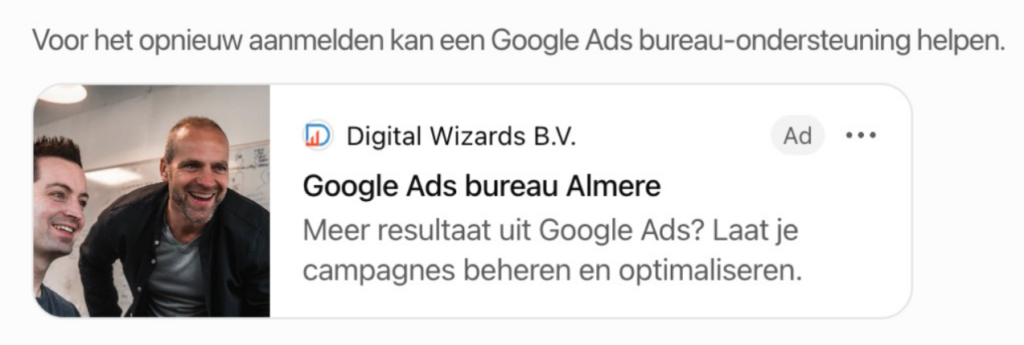
ChatGPT Ads are ad blocks that appear below or around an answer and are explicitly labeled as ads. They are visually separated from the substantive answer, so the user can tell what is organic and what is paid.
Importantly, these are not traditional search ads like those you’re familiar with from Google Ads. The ad is more closely tied to the conversational context than to a single keyword, although your targeting is, of course, still based on relevant signals and campaign settings.
Example ChatGPT ad
What can you actually do with advertising on ChatGPT?
The practical features are useful but not spectacularly new. You can display ads to ChatGPT users in the Netherlands as part of the rollout that has been underway across 31 European markets since August 24, 2026, as long as your target audience uses the free version or the Go subscription.
In addition, you can redirect traffic to your own landing page and track it using your own UTM structure. It’s also possible to link your ChatGPT Ads account to ChatGPT for campaign optimizations and adjustments, if you wish to manage this yourself.
Specifically, this means, among other things:
Display ads in a defined context.
drive traffic to a dedicated page.
Use our own metrics framework for reporting.
adjust campaigns based on performance and user signals.
Test with a separate proposition or landing page.
What can’t you advertise using ChatGPT?
This is where most misunderstandings arise. You cannot influence ChatGPT’s response yourself, rewrite it, or have yourself mentioned in it. The ad layer runs on a different system than the language model, and that’s exactly where expectations often go awry.
You also won’t reach all users. Ads appear only in the free version and the Go plan. The Plus, Pro, Business, Enterprise, and Education plans remain ad-free. So if you’re counting on full coverage within the ChatGPT user base, you’ll quickly draw the wrong conclusion.
Why personalization works differently than it does at Google or Meta
ChatGPT Ads are not a direct copy of the targeting logic used by Google or Meta. That doesn’t mean targeting is pointless. It does mean you need to think in terms of context, intent, and available consent parameters, rather than in terms of the familiar forms of extremely refined audience segmentation. For many advertisers, this requires a different campaign setup and different expectations during the initial test.
When is generative engine advertising a good fit?
Generative engine advertising—as this type of advertising in ChatGPT is often called—is particularly interesting if you already have a solid foundation in SEA and conversion tracking. If your existing landing pages, value propositions, and metrics aren’t yet in order, using this channel will mainly just add extra noise.
For a market like the Netherlands, this channel is currently most relevant as an experiment, not as a replacement for your current performance mix. This is especially true since the available inventory, user distribution, and optimization capabilities are still under development.
How do you approach an initial test effectively?
A good test plan doesn’t start with a campaign, but with a question. Do you mainly want to uncover new intent, capture additional reach, or see if the ChatGPT context converts better than other channels?
Keep the test small and well-defined. Choose one goal, one landing page, and one measurement model so you can see what happens without trying to prove everything at once.
Also pay attention to proper settings such as max. CPC, UTM tagging, and conversion tracking, because otherwise a test can quickly go wrong.
What does this mean for your business?
Advertising on ChatGPT is currently most interesting for companies that already have control over their sales funnel, measurement, and offerings. If you have an existing SEA structure, a solid UTM setup, and room for a dedicated test budget, then an initial trial might make sense—especially if you want to stay ahead of your competitors.
Frequently Asked Questions About Advertising on ChatGPT
1. Can you really advertise on ChatGPT now?Yes, but only within the available ad space and not in the response itself. You reach users through a separate ad block that is visually distinct from the generated text. Exact availability depends on the country, subscription, and rollout.
2. Does an ad influence ChatGPT’s response?No. The language model itself remains separate from the ad layer, so you cannot have a response modified or your brand included in it. That is an important distinction that is often misunderstood.
3. Who sees ChatGPT Ads in the Netherlands?As far as is currently known, ads appear only to users of the free version and the Go subscription. Users of Plus, Pro, Business, Enterprise, and Education do not see ads. Therefore, you do not reach the entire user base.
4. Can you target audiences as precisely as in Google Ads?Not in the same way. Stricter rules apply to personalization and consent, making targeting more limited and context-driven. So expect fewer profile-driven options than you might be used to.
5. Is ChatGPT advertising suitable for every business?No, definitely not. It works best if you already have a clear value proposition, a good landing page, and reliable metrics. Without that foundation, it’s difficult to fairly evaluate this channel.
6. What metrics do you need for a test?At a minimum, your own UTM structure, conversion tracking on your landing page, and a way to assess traffic quality. This will help you better determine whether ChatGPT ads truly add value. Tracking clicks alone is usually too superficial.
7. What is the difference between ChatGPT Ads and generative engine advertising?ChatGPT Ads are the specific ad format within ChatGPT. Generative engine advertising is a broader term for advertising in AI-driven search and answer environments. In practice, these terms are sometimes used interchangeably, but their implementation varies by platform.
8. When is it advisable to conduct an initial test?If your existing SEA structure is in order, your measurement plan is sound, and you can allocate a defined budget. Then you’ll be better able to assess whether the channel has a future within your marketing mix. Without those prerequisites, it’s often wiser to wait.
ChatGPT advertising in the Netherlands is real, but it’s still a far cry from the advertising machine you might be familiar with from other channels. If you’re looking for a partner to set this up with you, please contact Digital Wizards.
Want to get in touch?
Hans Boersma
Would you like to discuss AI, online marketing, or the growth opportunities for your website or online store? Feel free to contact Digital Wizards founder Hans Boersma.
WordPress Benefits WordPress is the most widely used Content Management System (CMS) in the world. More than one-third of all websites on the internet…
What is link building? With link building, you build high-quality backlinks to your website or key pages on your website. With link building, you aim not only to attract visitors…
As an online marketing agency, we naturally know everything there is to know about Google Shopping. We strive for profitable revenue in the short term and for long-term online growth.
To provide the best experience, we use technologies such as cookies to store and/or access information about your device. By consenting to these technologies, we may process data such as browsing behavior or unique IDs on this site. If you do not give consent or withdraw your consent, this may adversely affect certain features and capabilities.
Functional Always active
Technical storage or access is strictly necessary for the legitimate purpose of enabling the use of a specific service explicitly requested by the subscriber or user, or for the sole purpose of carrying out the transmission of a communication over an electronic communications network.
Preferences
Technical storage or access is necessary for the legitimate purpose of storing preferences that have not been requested by the subscriber or user.
Statistics
Technical storage or access used exclusively for statistical purposes.Technical storage or access used exclusively for anonymous statistical purposes. Without a subpoena, voluntary compliance by your Internet Service Provider, or additional data from a third party, information stored or retrieved solely for this purpose cannot usually be used to identify you.
Marketing
Technical storage or access is required to create user profiles for sending advertisements, or to track the user on a site or across different sites for similar marketing purposes.